
Summary :
This forecasting services help businesses turn data into confident decisions. A team of analysts who use your past and present data, statistical and machine learning methods, and industry judgment to predict demand, revenue, costs and risk. The process runs from cleaning data and choosing models to building scenarios, validating against actuals and turning results into recommendations. Common uses of forecasting services include demand, sales and financial forecasting, plus risk planning. Benefits include less guesswork, better team alignment and access to expert modeling. The blog also lists criteria for choosing a partner and closes with an FAQ covering accuracy, data needs and in-house versus outsourced forecasting.
Most businesses are not short on data. Sales reports, inventory logs, financial statements and customer records pile up every month. The real challenge is turning that information into confident decisions about what to stock hire, spend and invest.
This is where forecasting services come in. A good forecasting service looks at your numbers applies methods that have been tested for years and adds the judgment of people who know your industry. The result is a realistic picture of what’s coming. you stop guessing and start planning around something solid and you spot the risks and openings while there’s still time to act. Below, I’ll cover how the process works, where it’s most useful and what to look for in a partner.
What Are Forecasting Services?
A forecasting service is a team of analysts you bring in to look ahead for you. They take your past and present data, such as sales, costs and customer activity and use it to estimate what’s likely to happen with demand, revenue, expenses and risk. You don’t get a spreadsheet that goes stale after a month. You get forecasts built with statistical and machine learning methods plus clear advice on what to do next.
They differ from forecasting software which gives you a tool to run yourself. A service adds expert judgment model tuning and ongoing support. which suits business forecasting without a dedicated data science team.If you’ve come across predictive analytics for business, this will sound familiar. Both start with what has already happened and use it to work out what’s likely next. The people who hire forecasting services are usually retailers, manufacturers, distributors and service firms.
They need dependable numbers to plan with but nobody on the team has the spare hours to build them. What they get is a forecast shaped around their own market, data and goals, not a template someone reused from another company.
How Forecasting Services Turn Raw Data Into Decisions
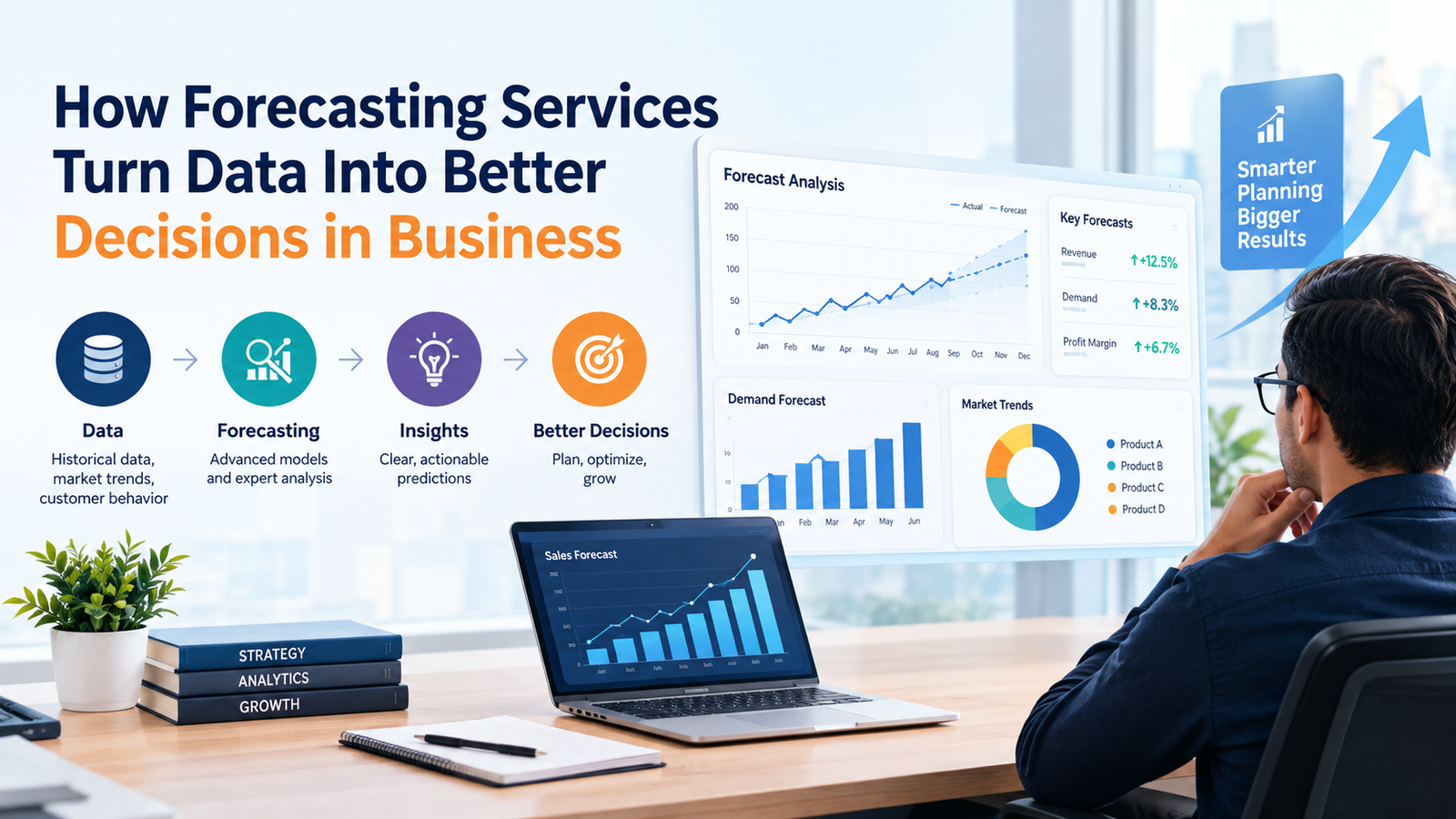
Good forecasting follows a repeatable process. Each step moves the business from scattered data to a clear decision.
1. Collect and clean data : Sales, finance, operations and market data are gathered then checked for gaps, errors and duplicates. Clean inputs matter because even the best model cannot fix unreliable data.
2. Select the right models : Forecasting methods such as time-series analysis, regression and machine learning are matched to the question and the data available. A short-term sales forecast needs a different approach than a three-year budget.
3. Build forecasts and scenarios : Teams receive a base case plus best and worst cases, so plans account for uncertainty.
4. Validate against actuals : Forecasts are compared with real results and models are refined to improve forecast accuracy over time.
5. Turn outputs into recommendations : Numbers become actions such as how much to order, when to hire or where to cut costs.
Reviews then repeat on a regular schedule so forecasts stay current as conditions change.
The last step matters most. A forecast only creates value when it changes a decision, which is why clear reporting is as important as the model itself. Executives rarely need every model detail. They need to know what is likely to happen how confident the forecast is and what to do about it. This is the core of data-driven decision making.
Where Businesses Use Forecasting Services to Improve Decisions
Demand forecasting : Predicting customer demand helps teams set inventory levels plan procurement and match capacity to need. Retailers manufacturers and distributors use it to reduce both stockouts and excess stock. which frees up cash and improves demand forecasting service levels. Better demand signals also support smarter pricing and promotion timing.
Sales forecasting : Projected revenue guides targets pipeline reviews and hiring plans. When leaders know what to expect next quarter sales forecasting they can commit to growth, set realistic quotas and adjust early if results drift off course. It also gives marketing and operations a shared view of what is coming.
Financial forecasting : Forecasts of revenue, costs and cash flow inform budgets, funding needs and investment timing. With forecasting services, finance teams can plan borrowing, protect liquidity and time major purchases instead of reacting after the numbers have already moved. Reliable financial forecasting also builds credibility with lenders and investors.
Risk and scenario planning : Scenario planning tests the bad outcomes: a drop in demand, a late supplier, a sudden rise in costs. Knowing how each would hit the business lets you prepare contingency plans in advance. That makes you more resilient when conditions shift, and it’s most valuable when the market is unpredictable and one forecast can’t be trusted on its own.
Benefits of Using a Forecasting Services
Working with a specialist provider offers practical advantages:
● Less guesswork with decisions based on evidence rather than instinct
● Faster planning cycles and fewer last-minute adjustments
● Better alignment between sales, finance and operations teams
● Lower risk of overstocking, shortfalls and budget overruns
● Access to modeling expertise without building an in-house team
● Clearer accountability, since forecasts create measurable targets to reviewAccuracy is usually tracked through measures such as mean absolute percentage error, which compares forecasts with actual results over time. Tracking forecast accuracy matters because it shows whether a model deserves trust and where it needs improvement. For growing companies, the support that forecasting services provide can be the difference between reacting to change and planning for it.
How to Choose the Right Forecasting Services Partner
Not every provider fits every business so compare options against clear criteria. Look for these qualities:
● Industry experience: familiarity with your sector’s demand patterns and risks
● Transparent methodology: clear explanations of models and assumptions
● Accuracy tracking: regular reporting of forecast performance against actuals
● Data security: strong practices for handling sensitive business data
● Actionable reporting: outputs that non-analysts can understand and use
● Scalability: capacity to grow with your data and needs
Ask for examples of how past forecasts led to specific business decisions strong providers can show the link. Also confirm how the provider handles onboarding forecasting services support and updates since forecasting is an ongoing process rather than a one-time report. A good partner should be as comfortable explaining the method as delivering the numbers.
FAQ’S :-
What are forecasting services?
Forecasting services use data, statistical models and expert analysis to predict future outcomes such as demand, sales and costs, helping businesses plan with greater confidence. Instead of relying on instinct or outdated spreadsheets, a specialist team studies your past and present numbers, builds tested forecasts and explains what they mean. You get clear, practical guidance on what to order, hire, spend or invest next.
How accurate is business forecasting?
Accuracy depends on data quality the forecast horizon and market stability. Short-term forecasts are generally more reliable than long-term ones business forecasting
and good providers track and report error rates openly. Ask any provider for historical accuracy results.
What data is needed to start?
You don’t need a perfect data warehouse to get started. Most projects begin with what you already have: past sales, financial records and operational figures, ideally going back a few years. The more history there is, the easier it is to spot patterns like seasonal swings. Outside information, such as market trends, can sharpen the picture too. And if your data is messy or scattered across different files, a good provider will usually help you clean it up and organize it.
Is a forecasting service better than in-house forecasting?
There’s no single right answer. It comes down to what you have in-house. If your team is short on time or nobody has forecasting experience, a service saves you from learning it the hard way. If you already have a solid data team, you may be able to handle it yourself. Plenty of companies land in the middle, with their own people running day-to-day numbers and an outside provider handling the harder, bigger-picture forecasts.