
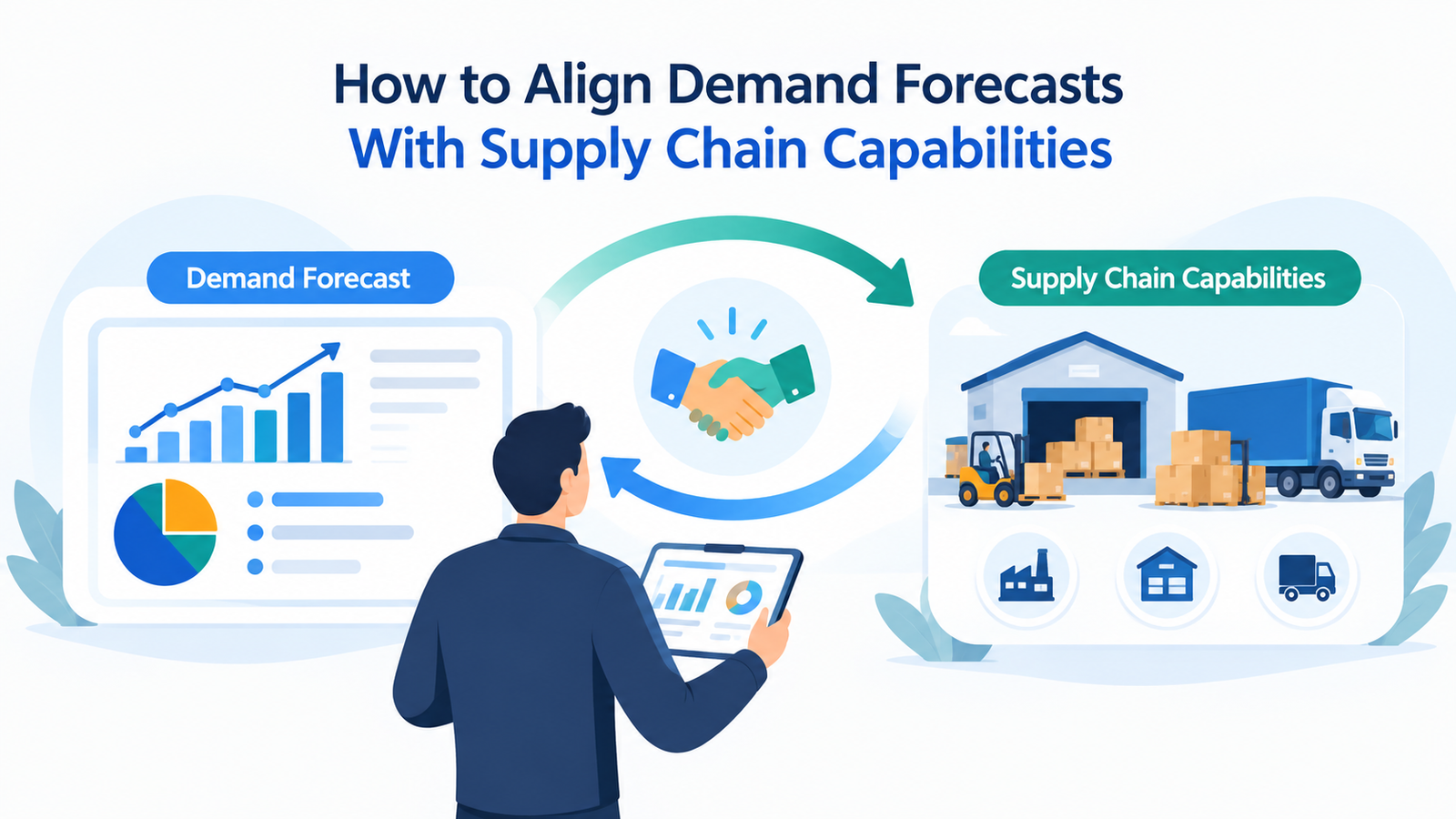
Demand and supply planning works only when demand forecasts match what your supply chain can actually deliver. Most brands already forecast, yet the forecast and the supply plan are built separately, so the numbers look fine on paper and fail on the warehouse floor. IHL Group’s 2025 research estimates that retailers lose 6.5% of global retail sales to out-of-stocks and overstocks. This guide shows how to align demand forecasts with supply chain capabilities, why they drift apart, and a five-step framework that holds up in practice.
Why Demand Forecasts and Supply Capabilities Drift Apart
Alignment breaks down for structural reasons, not because teams are careless.
● Different owners. Sales or finance builds the forecast, while operations and procurement own capacity.
● Unconstrained forecasts. Demand forecasting in the supply chain often starts with what customers might buy, not what can be produced or shipped.
● Late signals. Promotions and launches reach supply planners after lead times lock in.
● Hidden variability. Supplier lead times and yields move, but plans treat them as fixed.
● Siloed metrics. Sales is rewarded for volume and operations for cost.
The result is a plan that looks achievable until demand arrives. Lead times stretch, shelves empty and teams pay for air freight to catch up. Weak demand and supply planning is costly: IHL Group’s 2023 study named supplier issues the largest driver of inventory distortion, at $418 billion.
How Do You Align Demand Forecasts With Supply Capacity? A 5-Step Framework
To align demand forecasts with supply capacity in demand and supply planning convert the forecast into capacity needs, map real supply limits, compare the two week by week, close each gap with the lowest-cost lever, and lock the process into a monthly S&OP cycle. We call this the Forecast-to-Capacity Alignment Loop.
Step 1: Translate the forecast into capacity requirements
Convert units into the resources needed to deliver them: production hours, pallet positions, dock slots and transport loads. This moves you from an unconstrained forecast, which shows pure demand, to a constrained forecast, which shows what you can realistically fulfill. Start with the top 20 percent of SKUs, which usually drive most volume and risk. Without this step, a capacity problem stays invisible until it becomes a stockout.
Step 2: Map real supply capabilities
Document what your supply chain can deliver week by week: supplier capacity, minimum order quantities, lead times and their variability, changeover limits, and warehouse and carrier constraints. Use observed performance, not contract promises. A supplier who quotes ten days but delivers in fourteen should be planned at fourteen. Refresh this map monthly.
Step 3: Run a gap analysis with scenarios
Compare required capacity with available capacity week by week and flag every period where demand exceeds supply. Flag gaps by SKU, week and constraint type, such as supplier, plant or transport. Build base, upside and downside cases, and write assumptions beside each so reviewers can challenge them. The upside case matters most for supply chain capacity planning, because it shows how much flexibility your demand and supply planning needs before a promotion or peak season, not after.
Step 4: Close gaps with supply and demand levers
Every gap has two kinds of fix. Supply levers include pre-building inventory, overtime, an alternate supplier and higher safety stock. Demand levers include shifting promo timing, allocating limited stock to priority accounts and adjusting pricing. Rank levers by cost per unit protected and speed to execute. In the example below, pre-building costs about $0.40 per unit, a second supplier adds $1.20 and air freight adds $6.00, so air freight is the last resort. Record each decision and its owner. Sound inventory planning connects both sides, so you do not fix one shortage by overbuying elsewhere.
Step 5: Lock in a monthly cadence
One-off alignment fades within weeks. Run a monthly S&OP process for demand and supply planning with one consensus plan, frozen windows so late changes follow an approval path, and a named owner for every decision. Publish decisions within 24 hours so teams act on one plan. A sample 60-minute agenda:
1. Demand review: consensus forecast, promo and launch changes.
2. Supply review : capacity, lead times and supplier risks.
3. Gap resolution : choose levers, assign owners.
4. Executive sign-off : approve one plan and log open risks.
Worked example : A retail brand forecasts 40,000 units for a May promotion, but its supplier can deliver only 30,000 by the ship date. Steps 1 to 3 expose the 10,000-unit
gap in March. The team closes it as follows:
● Pre-build 4,000 units in March on spare capacity (about $1,600).
● Qualify a second supplier for 3,000 units (about $3,600).
● Move the promo start back one week, gaining one more week of supplier output (2,000 units).
● Cut 1,000 units from the lowest-margin account.
Total: 4,000 + 3,000 + 2,000 + 1,000 = 10,000 units, so the gap closes fully. Direct extra cost is about $5,200, versus $60,000 to air-freight the whole gap.
Which KPIs Show Your Forecast and Supply Are Aligned?
Track these five measures together.
| KPI | What it tells you | Healthy trend |
|---|---|---|
| Forecast accuracy (MAPE) | Average size of forecast error | Falling |
| Forecast bias | Consistent over or under forecasting | Near zero |
| Capacity utilization | Share of capacity in use | Stable, with peak room |
| Fill rate | Orders filled from stock | Rising |
| OTIF | Orders delivered on time and in full | Rising |
Read them as a set. High forecast accuracy with a low fill rate usually points to a supply constraint, not a forecasting problem. Strong demand and supply planning pairs accuracy targets with service targets, and any miss should be traced to its source: forecast, supply or execution.
Common Mistakes to Avoid
● Treating an unconstrained forecast as a supply plan.
● Keeping the promo calendar inside the sales team.
● Using safety stock to cover a structural capacity gap.
● Aligning once a year instead of monthly.
● Measuring only forecast accuracy, not service outcomes.
FAQ’s
What is demand-supply alignment?
It is the process of matching the demand forecast to what suppliers, production sites and logistics networks can realistically deliver. Good demand and supply planning produces one constrained plan that sales, finance and operations all agree on.
What is the difference between demand planning and supply planning?
Demand and supply planning combines two jobs. Demand planning forecasts what customers will buy and when. Supply planning decides how to meet that demand through production, purchasing and distribution. S&OP reconciles the two, so sales, finance and operations follow one plan, avoid conflicting targets and respond to changes together.
How often should forecasts be reviewed against capacity?
Review forecasts against capacity at least monthly in your S&OP cycle, when sales, finance and operations agree on one demand and supply planning view. Promotion-heavy brands and volatile supply bases should also check the next four to eight weeks weekly, so gaps are caught while there is still time to act.
What is a constrained forecast?
A constrained forecast adjusts demand for real limits such as supplier capacity, minimum order quantities, lead times and storage space. It shows the volume you can actually fulfill.