
Table of Contents
ToggleMAP vs UPP: 5 Proven Ways to Win on Price in 2026
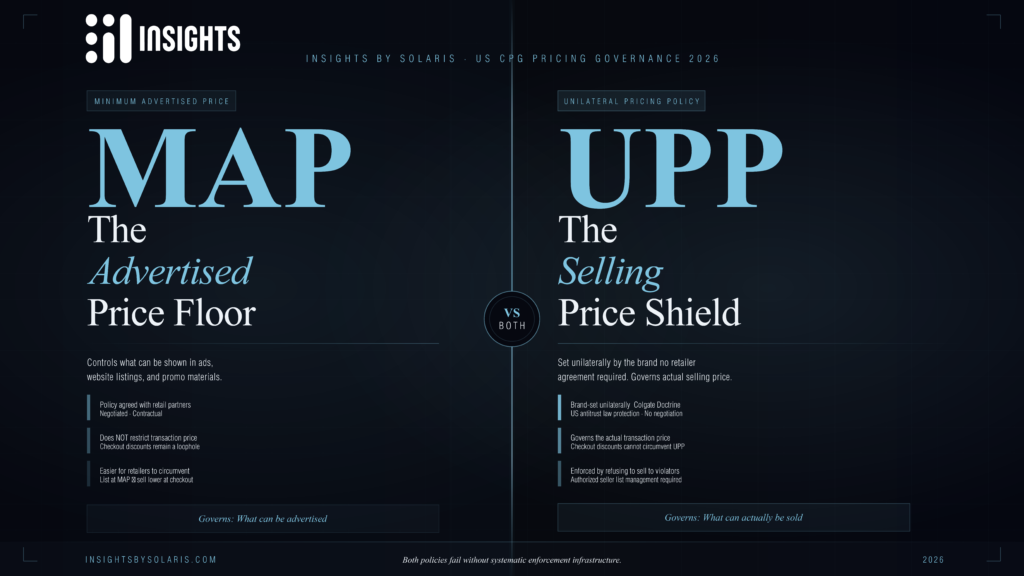
MAP vs UPP is the pricing decision most US brands get wrong. MAP (Minimum Advertised Price) controls the price a retailer can advertise. UPP (Unilateral Pricing Policy) controls the price a retailer can actually sell for. MAP can be dodged with checkout discounts. UPP closes that gap. Both only work with real enforcement behind them.
Most CPG brands already have a policy. A legal team wrote it, a sales director approved it, and it went to retail partners two years ago with a cover email. Since then it has been ignored, by retailers, by resellers, and by the brand itself.
The result is predictable. Prices drift, brand equity erodes, and the partners who follow the rules feel undercut. Then margins compress while volume still looks fine. The policy is rarely the problem. The enforcement is.
This guide covers the MAP vs UPP difference, where MSRP fits, why both fail without enforcement, and the 5 proven moves that protect your price across US retail in 2026.
MAP vs UPP vs MSRP at a glance
Here is the MAP vs UPP comparison in one view, with MSRP added because buyers confuse all three.
| MAP | UPP | MSRP | |
|---|---|---|---|
| Full name | Minimum Advertised Price | Unilateral Pricing Policy | Manufacturer's Suggested Retail Price |
| Controls | Advertised price only | Actual selling price | Nothing, it is a suggestion |
| Needs reseller agreement? | Often treated as one | No, brand sets it alone | No |
| Enforceable? | Yes, by reseller termination | Yes, by refusing to supply | No |
| Main weakness | Checkout and coupon discounts | Needs transaction-level data | No teeth at all |
| Best for | Public price control | Full price control | A value anchor only |
What is UPP (Unilateral Pricing Policy)?
UPP is set by the brand alone, with no retailer agreement, and it governs the actual selling price. Sell below UPP and you are in violation, whatever the listing shows.
Because it covers the final price, UPP closes the checkout loophole MAP leaves open. It is harder to dodge, but harder to monitor, because you have to track what products actually sell for. In the MAP vs UPP choice, this is the core trade-off: public control versus transaction control.
What is MAP (Minimum Advertised Price)?
The MAP vs UPP split starts here. MAP sets the lowest price a retailer can advertise. It governs the ad, the listing, the email, and the paid placement. It does not touch the real transaction price.
That gap is the catch. A retailer can show MAP in the listing, then cut the price in the cart, at checkout, or with a coupon. The public price stays compliant while the real price undercuts everyone. It is the most common MAP workaround, and it is legal.
Is UPP legal? Colgate and Leegin
Yes, UPP is legal in the US when it is genuinely unilateral. The basis is the Colgate Doctrine from United States v. Colgate & Co. (1919), where the Supreme Court held a brand can state its expected resale prices and refuse to deal with sellers who ignore them, as long as there is no agreement.
That last part matters. The moment the policy becomes a mutual agreement, it risks resale price maintenance and antitrust exposure under the Sherman Antitrust Act. Leegin v. PSKS (2007) later moved these agreements to a case-by-case rule of reason standard, which gave brands more room.
None of this replaces legal advice. Pricing law is fact specific, so have an antitrust attorney review your policy language before you enforce.
Selling abroad changes things too. MAP-style pricing is often treated as anti-competitive in the UK and EU and can draw fines, and Canada allows it only inside a careful framework. Outside the US, the MAP vs UPP playbook does not transfer cleanly.
Why most brands fail to enforce MAP vs UPP policies
A policy without enforcement is a suggestion. In the MAP vs UPP debate, enforcement is where both lose. Five failures show up again and again.
1. No monitoring infrastructure. Most brands have nothing automated watching prices. They rely on spot checks, retailer complaints, or chance. By the time anyone notices, the undercut has been live for weeks.
2. No enforcement nerve. Sales teams do not want to discipline the retailers they depend on for their numbers. So enforcement is inconsistent, and inconsistency tells violators there are no consequences.
3. Policy gaps. Many policies never address marketplace sellers, bundles, subscription discounts, or clearance. Retailers exploit those gaps, and they do it legally.
4. Slow response. Even when a violation is caught, the fix crawls through teams and approvals. Something that should take 48 hours turns into a three-week investigation, and the damage compounds.
5. No documentation habit. Real enforcement needs evidence: timestamps, screenshots, seller identity, price history. Most brands do not collect it, which makes every enforcement conversation weaker.
5 proven ways to win on price in 2026
Whether you run MAP, UPP, or both, these five moves turn a paper policy into real protection. They are where the MAP vs UPP decision finally pays off.
1. Monitor every channel automatically. Watch the main site, the app, marketplace listings, promotional email, and paid ads. Daily monitoring flags violations inside 24 hours. For hero SKUs and major accounts, hourly monitoring earns its cost.
2. Identify the seller, not just the listing. When a violation hits Amazon or Walmart Marketplace, find the exact seller. You need to know if it is an authorized retailer, a grey market reseller, or an unauthorized distributor before you act.
3. Watch the real price, not just the ad. This is the UPP layer. Use transaction-level data, plus mystery-shopper or cart-level checks for e-commerce, where the checkout price often differs from the listed one.
4. Document and escalate in tiers. Capture the URL, screenshot, timestamp, seller ID, and the exact clause broken. Then escalate: first violation gets a written notice, second a supply review, third a supply termination or authorization removal.
5. Review quarterly and close the gaps. Look at violation frequency, resolution rate, and the loopholes each one exposed, then tighten the policy. Add an annual legal review so your language keeps pace with new tactics.
Run those five and the MAP vs UPP question stops being theoretical. The policy holds because the system behind it holds.
MAP vs UPP- Which should you use?
When weighing MAP vs UPP, use MAP if you want public price control with some retailer flexibility. It is the more balanced, brand-safe option for multi-channel and e-commerce brands, and the easier one to defend legally.
Use UPP if you are a premium brand that needs control over the real selling price and will invest in transaction-level monitoring. Many brands run both, with UPP closing the checkout loopholes MAP leaves open.
In the end, MAP vs UPP is the easy part. The enforcement system is what actually protects the brand.
What is the difference between MAP and UPP?
In MAP vs UPP, MAP controls only the price a retailer can advertise, while UPP controls the actual selling price. A retailer can show MAP publicly and still discount at checkout, but a sale below UPP is a violation regardless of the listing. UPP closes the loophole MAP leaves open.
Is a unilateral pricing policy (UPP) legal?
Yes, UPP is legal in the United States when it is genuinely unilateral. Under the Colgate Doctrine, a brand can set the prices it expects on resale and refuse to supply sellers who ignore them, as long as there is no mutual agreement. Once it becomes an agreement, it risks antitrust exposure.
Can a retailer sell below MAP?
Yes, in many cases. MAP restricts only the advertised price, so a retailer can keep the public listing at or above MAP while offering a lower price privately, through an in-cart discount, a coupon code, or at checkout. That is the main weakness of MAP, and why some brands move to UPP.
What is the Colgate Doctrine?
The Colgate Doctrine comes from United States v. Colgate & Co. (1919). The Supreme Court held that a manufacturer can announce the prices it wants on resale and choose not to deal with sellers who do not comply, provided there is no agreement. It is the legal foundation for unilateral pricing policies in the US.
MAP vs MSRP vs UPP: how do they differ?
MSRP is a suggested price with no enforcement. MAP is an enforceable floor on the advertised price. UPP is an enforceable floor on the actual selling price. MSRP is a value anchor, MAP protects your public pricing, and UPP protects what the product sells for at the register.
Why do most brands fail to enforce MAP and UPP?
Most brands lack automated monitoring, so violations run for weeks. Sales teams hesitate to discipline retailers they rely on, policy language leaves gaps, response times stretch into weeks, and evidence is not collected. The policy is usually fine. The enforcement is missing.
How do you enforce a MAP policy on Amazon?
Identify the specific seller behind the violation, not just the listing, to tell an authorized retailer from a grey market or unauthorized one. Document the URL, screenshot, timestamp, and the clause broken. Then escalate through clear tiers: written notice, supply review, and authorization removal for repeat offenders.
Which is better for my brand, MAP or UPP?
suits multi-channel brands that want public price control with some flexibility, and it is easier to defend legally. UPP suits premium brands that need control over the real selling price and can invest in transaction-level monitoring. Many brands run both, using UPP to close the checkout loopholes MAP leaves open.