
What Is Demand Planning? Function, Methodology, and Systems Explained
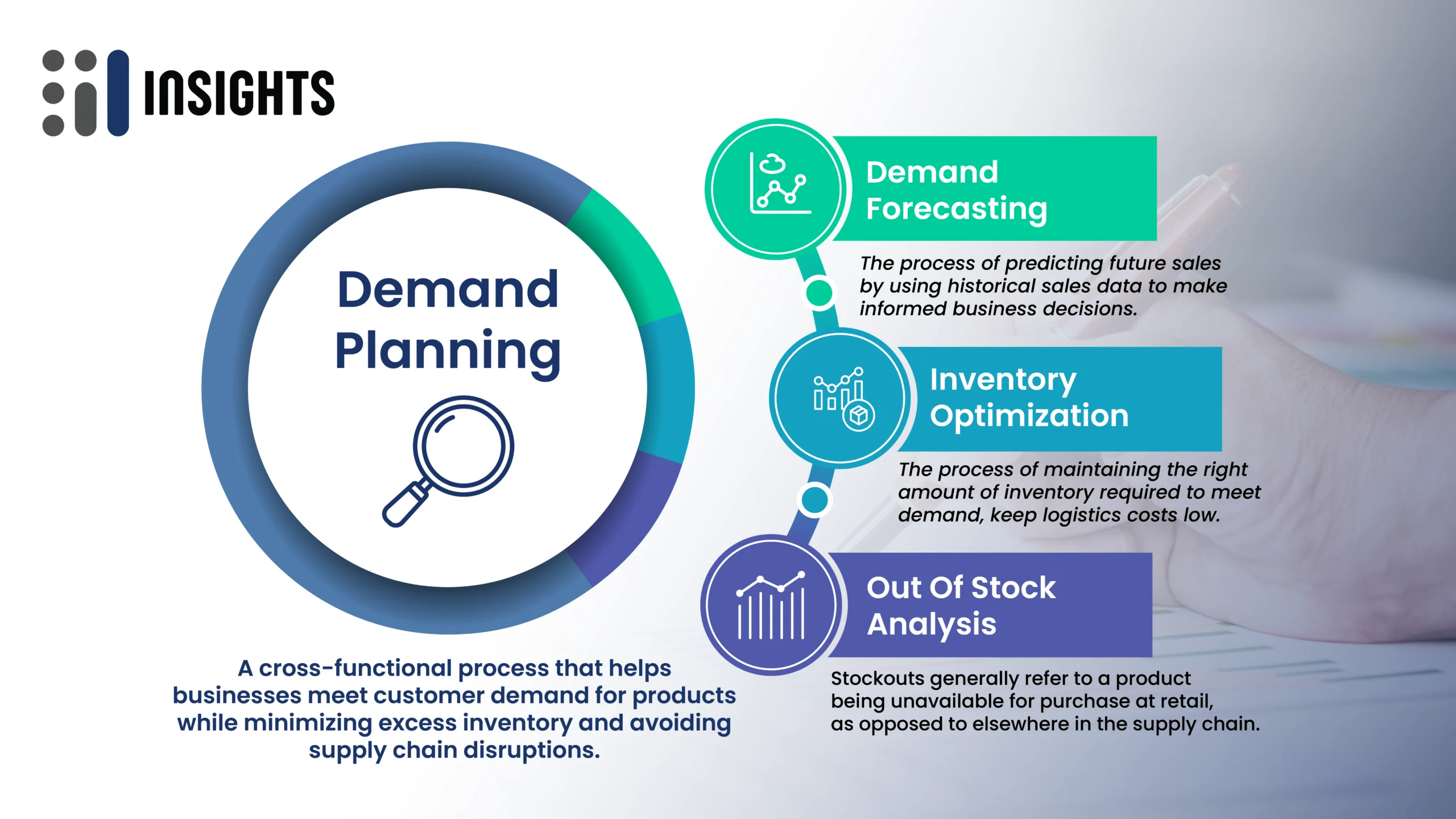
Demand planning is the cross-functional process of translating a demand forecast into coordinated business decisions covering inventory, supply chain, finance, and marketing. It is not a software feature or a meeting. It is the operating discipline that connects what your data says will happen to what your organization actually does about it.
In This Guide
- What is demand planning?
- Demand planning vs demand forecasting
- The demand planning function explained
- Demand planning methodology: the 5 core elements
- What a demand planning system actually does
- How to build the process
- Metrics that matter
- Common mistakes and how to fix them
- Frequently asked questions
Most supply chain conversations stop at the forecast. They shouldn't. Consider what actually happens in thousands of retail and CPG businesses every quarter: the analytics team builds a solid forecast. The numbers look right. The model is clean. Then the buying team places orders, the warehouse runs out of space on two fast-moving SKUs, and marketing runs a promotion on a product that is already back-ordered.
Nobody made a bad call in isolation. The forecast was accurate. But the plan fell apart because there was no process for turning that forecast into coordinated execution across departments. That is the demand planning problem.
What Is Demand Planning?
Demand planning is the structured process a business uses to turn a demand forecast into a concrete set of operational commitments. Those commitments cover what to order, when to order it, how to allocate across channels and locations, how to prepare the warehouse and supplier network, and how to respond when actual demand diverges from the projection.
The keyword here is "structured." Demand planning is not the same as reacting to demand as it arrives. It is a forward-looking, cross-functional discipline that runs on a defined cycle with specific inputs, specific outputs, and clear accountability for who makes which decisions.
Think of the running shoe example. Your demand forecast says running shoe sales will increase 22% in March. Demand planning is everything that follows: which sizes to stock, how much buffer inventory to carry, whether the warehouse can handle the inbound volume, whether the supplier can fulfill on that timeline, and whether the spring marketing campaign is timed to land before shelves run dry rather than after.
Demand Planning vs Demand Forecasting: Why the Difference Matters
These two terms get used interchangeably. That is where most organizations run into trouble. They are related but they are not the same thing, and conflating them leads to a process gap that costs real money.
| Dimension | Demand Forecasting | Demand Planning |
|---|---|---|
| Core question | What will customers buy? | What will we do about it? |
| Output | Numbers, trends, probabilities | Purchase orders, budgets, logistics plans |
| Who owns it | Analytics or data science team | Cross-functional: supply chain, finance, sales, ops |
| Decision type | Statistical and automated | Judgment-based and human-reviewed |
| Value created | Accuracy of prediction | Quality of execution |
| Failure mode | Wrong numbers | Right numbers, wrong actions |
The forecast is the input. The plan is the output. One without the other is either useless information or organized guessing. A precise forecast with no planning discipline produces stockouts and surplus at the same time on different SKUs. Good planning with a weak forecast is just an expensive way to manage uncertainty.
Solaris Perspective
The brands that struggle most are not the ones with bad data. They are the ones with good data and no process for acting on it. The forecast gets generated, shared via email, and then each department interprets it independently. Nobody reconciles those interpretations until something goes wrong.
The Demand Planning Function: What It Is and Who Owns It
The demand planning function is the organizational discipline responsible for producing a consensus demand plan on a recurring cycle, coordinating input from supply chain, sales, marketing, and finance, and connecting that plan to the execution systems that actually move inventory.
In a well-structured organization, this function sits at the intersection of analytics and operations. It is not purely a supply chain function, even though it often lives there. And it is not a data science function, even though it relies heavily on statistical outputs. It is a coordination function, and its value comes from what it connects rather than what it produces in isolation.
Why the demand planning function fails in most organizations
The most common failure is structural: nobody formally owns the function. The forecast gets generated by analytics, shared with supply chain, interpreted differently by merchandising, and never reconciled into a single agreed plan before orders are placed. Every team is doing their own version of demand planning independently, without a process that brings them to a common set of commitments.
The second common failure is scope. When the function lives inside supply chain only, the people with the best commercial intelligence, those who know about the promotional plan, the new product launch, the competitive threat, are not in the room. The result is a plan that is operationally sound and commercially blind.
What does a demand planner actually do?
Planning responsibilities
Generate and lock the statistical baseline. Facilitate cross-functional demand review. Produce the consensus demand plan. Map constraints against plan output. Track forecast accuracy and forecast value added.
Coordination responsibilities
Align supply chain, finance, sales, and marketing on a single plan version. Translate the volume plan into financial implications. Connect the approved plan to procurement and WMS systems. Maintain scenario playbooks for forecast error.
Demand planning function vs S&OP
Sales and Operations Planning (S&OP) is the broader process that brings the demand plan, the supply plan, and the financial plan into a single integrated view. Demand planning is one of the primary inputs to S&OP: it produces the demand signal that S&OP reconciles against supply constraints and financial targets. You need both. Demand planning without S&OP produces a demand plan that never gets tested against operational reality. S&OP without a structured demand planning function produces an integrated plan built on a weak foundation.
Demand Planning Methodology: The 5 Core Elements
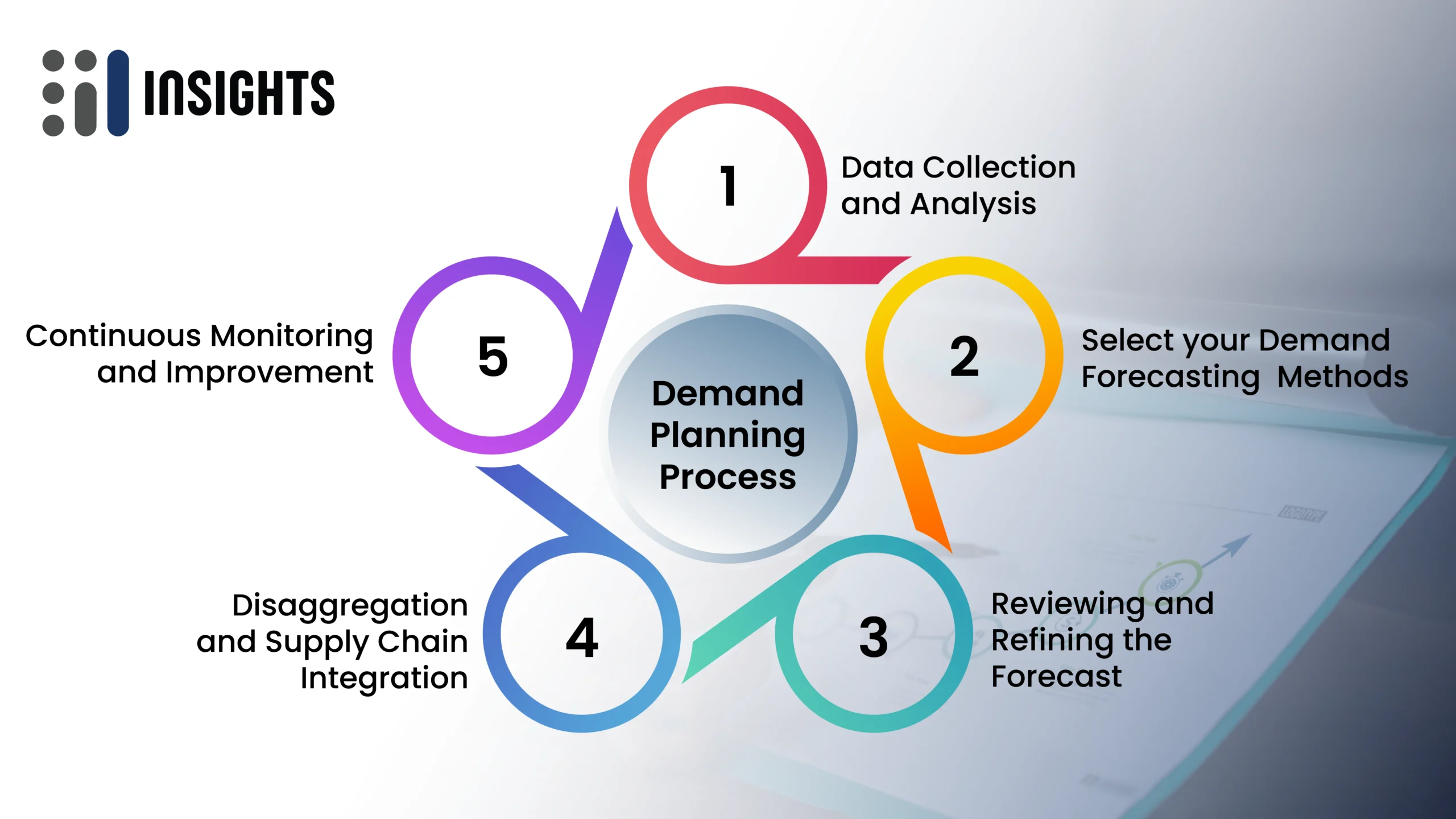
Demand planning methodology refers to the structured approach an organization uses to move from a raw statistical forecast to a validated, actionable consensus demand plan. The standard methodology runs across five interconnected elements. Skip any one of them and the process breaks at that seam.
Element 1: A locked statistical baseline
The methodology starts with a frozen statistical baseline: one version of the numbers the whole organization works from. Generated by the forecasting model, it represents the best algorithmic estimate before any human judgment is layered on top.
Why locking the baseline matters
Teams should be able to add overrides and adjustments on top of the baseline, but they should not quietly substitute their own numbers without flagging the change. If everyone works from a different starting point, you cannot measure whether human judgment is actually improving the forecast over time. Locked means auditable.
Element 2: A structured cross-functional demand review
This is the meeting most organizations either skip entirely or run as a passive slide presentation where nobody makes decisions. Done correctly, it brings together supply chain, merchandising, sales, marketing, and finance to review the statistical baseline and add the intelligence the model cannot capture: promotional plans, competitor activity, new product launches, known supply disruptions.
The output is a consensus demand plan: a forecast that has been validated and enriched by the people who will execute against it. Anyone who overrides the statistical baseline owns the reasoning and the accountability for the result.
Element 3: Constraint mapping
A consensus demand plan is still just a wish list until you run it through the real-world constraints of the business. Can the warehouse absorb this volume? Can the supplier fulfill on this timeline? Does the required inventory investment fit within the working capital envelope?
Constraint mapping almost always changes the plan. That is not a failure, it is the point. Better to surface the gap in week eight of planning than in week two of execution when options have narrowed.
Element 4: Financial alignment
The volume plan and the financial plan need to be the same plan. In most organizations they are not. The demand planning team and finance operate from different models and reconcile only at month end, when adjustments are no longer possible. A mature demand planning methodology runs the volume plan through a financial lens in real time, flagging cash flow implications before commitments are made.
Element 5: Scenario planning for forecast error
Even a highly accurate forecast will be wrong some percentage of the time. The final element of sound demand planning methodology is a set of pre-committed responses to the scenarios where the forecast is materially off. If demand runs 20% above baseline, what happens? If it runs 20% below, what is the playbook? Teams that have answered these questions in advance make better decisions faster when reality diverges from the plan.
Methodology at a glance
- Statistical baseline: Lock one version of the algorithmic forecast that the whole organization works from, with all overrides tracked separately.
- Cross-functional demand review: Bring supply chain, sales, marketing, and finance to a structured session where the baseline is enriched with commercial intelligence the model cannot capture.
- Constraint mapping: Run the consensus plan against warehouse capacity, supplier lead times, and working capital before any commitments are made.
- Financial alignment: Reconcile the volume plan with the financial model in real time, not at month end.
- Scenario playbooks: Pre-commit to response protocols for demand outcomes that deviate materially from the plan.
What Is a Demand Planning System?
A demand planning system is the combination of software, process, and people that translates demand signals into operational decisions. The term covers a spectrum: from basic spreadsheet-based planning workflows to sophisticated integrated business planning (IBP) platforms that connect statistical forecasting, consensus planning, constraint modeling, and financial reconciliation in a single environment.
The two layers of a demand planning system
Layer 1: Statistical forecasting engine
Generates the demand baseline using historical sales data, external signals, and machine learning models. Works automatically and produces SKU-level, location-level, channel-level predictions. Examples include SAP IBP, o9 Solutions, Kinaxis, and Blue Yonder.
Layer 2: Consensus planning layer
The human layer where cross-functional teams review the statistical output, apply overrides with reasoning, run constraint scenarios, align with finance, and produce the approved demand plan that feeds into procurement and WMS systems.
What are the benefits of demand planning software?
The core benefits of demand planning software operate across three areas: speed, accuracy, and integration. A purpose-built demand planning system automates the statistical baseline so planners spend less time generating numbers and more time challenging them. It provides scenario modeling across multiple demand outcomes so constraint planning can happen before commitments are made. And it integrates directly with ERP and procurement systems to eliminate manual handoffs where value typically leaks out.
Specific benefits of demand planning software by function
- Automated statistical baseline generation: Eliminates the manual work of building forecasts in spreadsheets, reduces baseline generation time from days to hours, and allows planners to update the baseline as new data arrives rather than waiting for a monthly cycle.
- Multi-level granularity: Plans at SKU, location, and channel level simultaneously, with automatic aggregation for executive views. Catches the channel-specific imbalances that blended forecasting misses.
- Scenario modeling: Lets planning teams model upside and downside demand scenarios before commitments are made, so constraint gaps and financial implications are visible before the plan is locked.
- Forecast value added tracking: Measures whether human overrides to the statistical baseline improve or reduce accuracy over time, so planning energy can be focused where human judgment actually adds value.
- ERP and WMS integration: Connects the approved demand plan directly to procurement, warehouse management, and financial planning systems, removing the manual step where most organizations lose plan fidelity.
- Cross-functional visibility: Gives supply chain, finance, sales, and marketing a single view of the plan so each function can make decisions from the same baseline rather than managing separate models.
How to choose a demand planning system
The market splits into two broad categories. Statistical forecasting platforms generate the demand signal. S&OP or IBP platforms manage the consensus planning process, constraint modeling, and financial reconciliation. The right choice depends on organizational size, category complexity, and existing ERP infrastructure.
The most important question to ask any vendor: does the platform separate the statistical forecast from the consensus plan and track both independently? If the answer is no, you cannot measure whether your planning process adds value over time.
Major demand planning software providers
Enterprise-scale: SAP IBP, o9 Solutions, Kinaxis RapidResponse, Blue Yonder, Oracle Demantra. Mid-market: Logility, Infor Nexus, Relex Solutions. Growth-stage: Streamline, Netstock, Inventory Planner (Shopify-native). The tier that makes sense for a given organization depends less on revenue size and more on SKU count, channel complexity, and the number of locations that require independent planning.
Why Demand Planning Is Harder in 2026 Than It Was Five Years Ago
AI-powered forecasting has raised the accuracy ceiling
Modern forecasting tools now generate SKU-level predictions with accuracy rates that would have been impossible five years ago. That creates a new problem: when the forecast is highly precise, the bar for executing against it rises proportionally. A blurry forecast gives cover for a rough plan. A precise forecast does not.
If an AI model correctly predicts that 1,240 units of a specific SKU will sell in a specific region in a specific week, and the result is a stockout or a 400-unit surplus, that is not a forecasting failure. That is a planning failure. In 2026, more organizations are running into exactly this situation because the forecast got better faster than the planning process did.
Channel complexity has multiplied
Most demand planning processes were designed for a simpler world: one primary channel, one distribution network, predictable lead times. A mid-sized CPG brand today might sell direct-to-consumer, through Amazon, through two or three regional retail chains, and through wholesale, each with different demand patterns, different lead times, and different replenishment logic.
A single blended demand plan that does not segment by channel does not just underperform. It produces a plan that is simultaneously wrong for every channel. The fix is not a better model. It is a planning process that works at channel-level granularity from the start.
How to Build a Demand Planning Process That Actually Holds
Most demand planning processes fail not because the data is bad but because the operating model is wrong. The steps below apply across retail and CPG organizations of different sizes and different planning maturity levels.
Who is accountable for the consensus demand plan? Not the forecast. The plan. In most organizations this role does not formally exist, which means nobody owns the quality of the planning output. Name a demand planner or planning lead, make the accountability explicit, and make sure they have the authority to convene cross-functional input on a mandatory schedule.
Demand planning works on a cycle. Monthly is the standard cadence for most consumer businesses, with a weekly tactical review for short-horizon decisions. The cycle needs a hard schedule with mandatory participation from each function. Not an open calendar invite that gets declined when things get busy. When the planning meeting is optional, it becomes the first thing that gets cut.
Run one meeting to review the numbers. Run a separate meeting to make decisions. When you combine these into one session, the business review gets eaten by the data discussion and no decisions get made. Keep them distinct, keep them sequential. The statistical review produces the baseline; the business review produces the plan.
Measure whether human overrides to the statistical baseline actually improve accuracy over time. Most organizations find that some overrides add value and others reduce it. This data tells you where to spend planning energy and where to let the model run. Without tracking it, you are flying on instinct.
The demand plan should feed automatically into procurement, warehouse management, and marketing calendar systems. Manual handoffs between the plan and execution systems are where most of the value leaks out. Every manual step is an opportunity for the plan to be reinterpreted, delayed, or quietly overridden.
Demand Planning Metrics You Should Actually Track
There are dozens of metrics associated with demand planning. Most organizations track too many of the wrong ones and not enough of the right ones. These five are the ones that genuinely tell you whether the planning process is working.
- Forecast accuracy by SKU and channel: The baseline health metric. Measure at channel level, not blended. A blended accuracy of 85% can hide a channel running at 60%, which is where the stockouts and surplus actually occur.
- Forecast bias: Are you consistently over-forecasting or under-forecasting? Systematic bias is more damaging than random error because it compounds over time. Positive bias drives excess inventory. Negative bias drives stockouts. Both have a direct cost.
- Forecast value added (FVA): Does the consensus plan perform better than the statistical baseline? If human overrides consistently reduce accuracy, the review process is adding noise rather than insight. FVA is the single most important diagnostic metric in demand planning.
- Inventory turns: How many times average inventory sells through in a given period. Low turns indicate excess stock. Very high turns can mean demand you are not capturing. Both are signals worth investigating at the SKU level.
- Service level or fill rate: The percentage of customer orders fulfilled completely and on time. This is what your customers actually feel, and it is the downstream consequence of every planning decision made upstream. If fill rate is declining, work backward through the process to find where the plan broke down.
Common Demand Planning Mistakes and How to Fix Them
Treating demand planning as a supply chain function only
Demand planning touches every function with a stake in revenue. When it lives exclusively inside supply chain, the people with the best commercial intelligence, those who know the promotional plan, the new product pipeline, the competitive threat, are not in the room. The result is a plan that is operationally sound and commercially naive. Fix: formally include sales and marketing in every demand review with mandatory participation and shared accountability for plan accuracy.
Reviewing history instead of making decisions
The most common failure in demand planning meetings is spending 70% of the session explaining last month's misses and 30% on the forward plan. Flip the ratio. The purpose of a demand review is to make commitments about the future, not litigate the past. Designate a time limit for retrospective discussion and enforce it.
Planning at too high a level of aggregation
A plan built at product family or brand level will always miss at the SKU level where execution happens. Plan at the lowest level of granularity your data supports: by SKU, by channel, by location. Aggregate up for the executive view, but make actual decisions at execution level. The gap between family-level accuracy and SKU-level accuracy is often 20 to 30 percentage points.
Letting the algorithm handle edge cases it cannot handle
Statistical models are trained on history. They handle consistent seasonality well. They handle trend breaks, one-off events, and short shelf-life dynamics poorly. These are exactly the cases where human judgment in the consensus review adds value. A structured demand review must explicitly surface edge cases rather than letting the algorithm handle them silently in the background.
Disconnecting the plan from execution systems
Many organizations produce a solid consensus demand plan and then email it as an attachment for someone to manually input into a procurement or WMS system. That manual step is where plan fidelity collapses. The demand plan needs a direct, automated connection to execution systems. Every manual handoff is a point where the plan can be reinterpreted or delayed without accountability.
Frequently Asked Questions About Demand Planning
What is demand planning in simple terms?
Demand planning is the process of taking a prediction about future customer demand and turning it into a set of coordinated business decisions: how much inventory to order, when to order it, how to allocate across channels, and how to respond when the prediction is wrong. It is the bridge between what your data says will happen and what your organization actually does about it.
What is the demand planning function in a retail or CPG business?
The demand planning function is the organizational discipline responsible for producing a consensus demand plan, coordinating cross-functional input from supply chain, sales, marketing, and finance, and connecting the statistical forecast to execution systems. In a well-structured organization, it sits at the intersection of analytics and operations. In a less mature organization, it often exists informally inside supply chain or not at all, which is where most planning breakdowns originate.
What are the benefits of demand planning software?
The core benefits of demand planning software include automated statistical baseline generation, scenario modeling across multiple demand outcomes, real-time constraint mapping against warehouse and supplier capacity, financial reconciliation of the volume plan, and direct integration with ERP and WMS systems that eliminates manual handoffs. Purpose-built demand planning software also separates the statistical forecast from the consensus plan and tracks both independently, which is the only way to measure whether human judgment is actually improving the forecast over time.
What is demand planning methodology?
Demand planning methodology is the structured approach an organization uses to move from a raw statistical forecast to a consensus demand plan that the whole organization can execute against. The standard methodology includes five elements: locking a statistical baseline, running a cross-functional demand review, mapping constraints against the consensus plan, aligning the volume plan with the financial plan, and building scenario playbooks for forecast error. The specific tools and cadence vary by organization, but the five elements are consistent across mature planning operations in retail and CPG.
What is a demand planning system?
A demand planning system is the combination of software, process, and people that translates demand signals into operational decisions. It has two layers: a statistical forecasting engine that generates the demand baseline automatically, and a consensus planning layer where cross-functional teams review the baseline, apply overrides, model constraints, and produce the approved plan. Enterprise systems like SAP IBP, Kinaxis, and o9 Solutions handle both layers. Mid-market options include Logility and Relex. The right system depends on SKU count, channel complexity, and ERP infrastructure rather than revenue size alone.
Who is responsible for demand planning in a retail or CPG business?
In a well-structured organization, demand planning is owned by a dedicated demand planner or planning manager who coordinates input from supply chain, sales, marketing, and finance. In smaller organizations, the function often sits inside supply chain or operations. Wherever it sits structurally, the critical requirement is cross-functional participation. Demand planning cannot function as a one-department activity and produce a plan the whole organization can execute against.
How often should a demand plan be updated?
Most consumer businesses run a full demand planning cycle monthly, covering a 13 to 26-week horizon, with a shorter weekly tactical review for near-term adjustments. The monthly cycle sets the medium-term plan. The weekly review handles exceptions, promotional adjustments, and short-horizon supply issues. The cadence should be fixed and mandatory, not driven by how busy people are in a given week. When planning meetings become optional, they become the first thing cut, and the process collapses.
Can small CPG brands benefit from formal demand planning?
Often more immediately than large organizations. Smaller brands operate with tighter margins, less safety stock buffer, and fewer recovery options when a planning miss creates a stockout or excess inventory event. The return on a structured demand planning process is proportionally higher when the consequences of getting it wrong are more immediate. You do not need complex software to start. You need a defined process, a fixed cadence, and cross-functional participation. A well-run monthly planning cycle in a spreadsheet outperforms an expensive software platform with no process discipline behind it.
Insights by Solaris
We work with retail and CPG brands closing the gap between what their data predicts and what their teams actually execute. If your demand planning process is not producing the inventory turns, service levels, or revenue results your forecast suggests are possible, the fix is usually in the planning process, not the forecast model.