
Table of Contents
ToggleDemand Forecasting vs Demand Planning
Picture this: You walk into a store during the holiday rush. Half the shelves are completely bare, yet the clearance rack in the back is overflowing with stuff nobody actually wants.
That is not just bad luck. That is the brutal difference between knowing what might happen and actually doing something smart about it.
Let me tell you about Marcus. Marcus runs a mid-sized sporting goods chain called Peak Performance. He has twelve locations, a solid e-commerce presence, and like most retailers, he spends his days trying to figure out how to keep the right products in stock without drowning in inventory costs.
Last year was rough. March rolled around, and Marcus was stuck with 2,000 winter jackets nobody wanted. Meanwhile, his running shoe section looked like a crime scene—completely cleaned out. Frustrated customers were walking straight to his competitors. His CFO wasn’t happy. His store managers weren’t happy.
The craziest part? Marcus actually knew it was going to happen. He just didn’t realize it.
The Trap: When Accurate Predictions Aren't Enough
Marcus thought he had his inventory under control. Every month, his team pulled sales reports, looked at last year’s numbers, and ran the algorithms. His system correctly predicted that running shoes would surge by 15% and winter jackets would drop off.
The predictions were highly accurate. The problem? Predictions alone do not put products on shelves or money in the bank.
That is when Marcus learned the hard way that Demand Forecasting and Demand Planning are not the same thing.
 Demand Forecasting: Just Numbers on a Screen
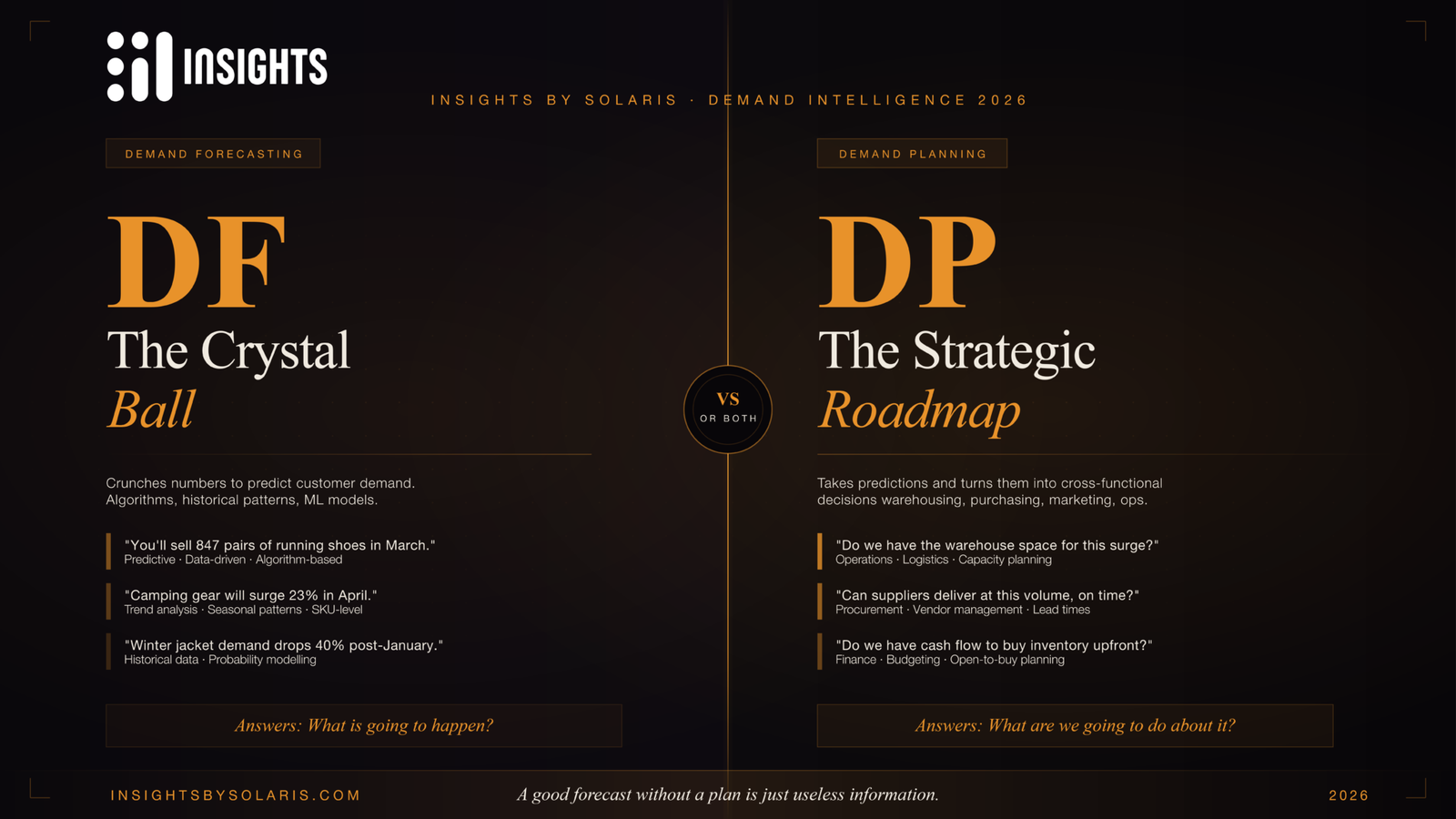
Think of demand forecasting as your retail crystal ball, powered by data instead of magic. It is all about crunching numbers to predict customer behavior.
For Marcus, this meant looking at historical patterns and algorithms. His system would spit out predictions like:
“You will sell 847 pairs of running shoes in March,” or “Expect camping equipment to increase 23% in April.”
Pretty straightforward, right? But here is what Marcus realized: knowing you will sell 847 pairs of running shoes doesn’t tell you which sizes to order, when to mark down last season’s inventory, or how to fit those boxes in your warehouse..
 Demand Planning: Where Things Get Real
Demand planning is where you take those pristine predictions and turn them into messy, strategic business decisions. It involves basically every single department in your company.
When the forecast says, “Camping equipment sales will go up 23%,” a real demand plan asks a dozen hard questions:
○ Do we actually have the warehouse space for this?
○ Can our suppliers even deliver that much volume on time?
○ Should we shift our store floor plans away from winter sports a week earlier?
○ What if the forecast is wrong and it’s actually 30% growth?
○ Do we have the cash flow to buy this inventory upfront?
The forecast gives you a target. The plan gives you a roadmap.
The Difference at a Glance
If you want to stop leaving money on the table, you have to separate these two functions in your mind:
|
Feature |
Demand Forecasting |
Demand Planning |
|
The Core Question |
What is going to happen? |
What are we going to do about it? |
|
The Nature |
Analytical, data-driven, and algorithm-based. |
Strategic, operational, and highly collaborative. |
|
The Output |
Numbers, trends, and probabilities. |
Purchase orders, marketing budgets, and supply chain logistics. |
Solaris Reality Check: A good forecast without a good plan is just useless information. A good plan without a good forecast is just guessing with extra steps.
5 Signs Your Team Is Treating Forecasting as Planning
Most organizations don't realize they've collapsed two distinct functions into one until they see the consequences on the shelf. Run through this list before your next planning cycle.
If the number your forecasting model generates skips a review step and lands straight in procurement, you're automating the wrong thing. The forecast is an input to the plan - not the plan itself. Every purchase decision needs a human layer that asks: do we actually have the cash, space, and supplier capacity to execute this?
When the person who builds the forecast is also the person who decides how much to order, there is no error-correction mechanism. Good demand planning requires a second set of eyes that asks uncomfortable questions - specifically around constraints the forecasting model can't see, like supplier minimums, freight consolidation windows, and promotional commitments.
If your CFO is learning about a large inventory commitment after the PO is placed, your demand planning process has a structural gap. Cash flow constraints, working capital targets, and seasonality of spend should shape the plan before it becomes an order - not surprise the finance team on the back end.
Marketing decides to run a flash sale on a SKU your buying team already cut back on based on a slow-demand forecast. Sound familiar? This happens when promotions are planned in a silo from inventory. A real demand plan synchronizes marketing calendars with supply decisions - not the other way around.
If your monthly review meeting is 80% spent on explaining why last month's forecast was off - and 20% or less on what you're going to do differently this cycle - you are running a forecasting post-mortem, not a planning session. The planning session should be forward-looking: given what we now predict, what actions do we commit to?
Solaris Reality Check: If three or more of these describe your operation, you don't have a forecasting problem. You have a planning infrastructure problem. Better data won't fix a broken handoff between your analytics team and your execution teams.
A Real 4-Step Process to Connect Forecasting and Planning
This is the workflow Marcus rebuilt at Peak Performance - and the same structure we use with every retail and CPG client. It takes the forecast output and turns it into a cross-functional plan within a single operating cycle.
Lock the forecast baseline
Before anything else gets discussed, the analytics or demand sensing team produces a single agreed-upon statistical forecast for the planning horizon - typically 12 to 16 weeks forward, broken down by SKU and location. This baseline uses historical data, seasonal indices, and any known market signals.
The key word here is locked. Once the baseline is set, teams can layer adjustments on top of it - but they cannot quietly substitute their own numbers without flagging it as an override. This creates accountability and allows you to measure forecast value added (FVA) over time.
Output: A frozen statistical forecast by SKU / locationCross-functional demand review
This is the meeting most companies skip or run badly. Supply chain, merchandising, sales, and marketing sit in the same room and review the baseline together. Each team adds intelligence the algorithm couldn't see: a competitor going out of stock, a planned promotion, a new product launch, a macro event affecting your category.
The output is a consensus demand plan - a version of the forecast that has been enriched and validated by the people who will execute against it. If a team overrides the statistical forecast, they own the reasoning and the accountability.
Output: A consensus demand plan with documented overridesConstraint mapping
Now you take the consensus demand plan and run it through the real world. Can your warehouse physically hold this volume? Do your suppliers have the capacity to deliver on this timeline? Does the cash requirement fit within your working capital envelope? Is there a minimum order quantity from the vendor that forces a decision?
This step almost always changes the plan. That's not a failure - it's the point. You'd rather find out your warehouse can't absorb the Q4 surge in week 8 of planning than week 2 of execution. The constraint map tells you where to flex: adjust order timing, negotiate supplier lead times, or pre-position inventory at a 3PL.
Output: A constrained supply plan and gap listScenario planning for forecast error
Even the best statistical forecast is wrong some percentage of the time. The final step is building two alternate scenarios: an upside case (demand runs 15–20% above baseline) and a downside case (demand runs 15–20% below). For each scenario, you pre-decide the trigger conditions and the response playbook.
When demand outpaces the forecast, your team already knows whether to pull forward inventory from another region, activate a backup supplier, or let the stockout happen on a low-margin SKU. When demand undershoots, you have a markdown strategy ready - not a crisis meeting to schedule.
Output: An upside / downside playbook with pre-committed triggersTools That Bridge Both Functions - and What to Look For
The software market splits cleanly into two categories that mirror the forecasting vs. planning distinction. Most organizations need one from each column. What matters more than the vendor name is whether the tool handles your specific category dynamics.
Category 1
Demand Sensing & Forecasting Platforms
Category 2
S&OP / IBP & Demand Planning Platforms
Common Mistakes CPG Brands Are Making Right Now
AI has reshuffled the deck on demand forecasting - accuracy is higher than it has ever been for most categories. But better predictions have created a new class of planning failures that most brands haven't caught up to yet.
Assuming AI-accurate forecasts remove the need for planning judgment
AI forecasting tools can now predict demand at the SKU-store level with genuinely impressive accuracy. But accuracy is a measure of the forecast - it tells you nothing about whether your supply chain can execute against it. When a model predicts 847 units by location, someone still has to decide the order quantity, timing, and distribution logic. Precision in the prediction layer makes planning more critical, not less - because now you're held accountable to a tight number.
Planning for one channel while selling across five
Most CPG demand plans were built for a world where the DTC website was the primary channel. Today, a brand might be selling on its own site, Amazon, Target.com, two regional retail chains, and a subscription box - each with different demand patterns, lead times, and fulfillment requirements. A single blended forecast that doesn't segment by channel produces a plan that's wrong for every channel simultaneously.
Using sell-in data to forecast sell-through
Sell-in tells you what shipped to the retailer. Sell-through tells you what consumers actually bought. When retail partners share POS data, many brands still run their statistical models on sell-in because that's what's available in their ERP. The result is a forecast that reflects retailer ordering behaviour - including their over-ordering and safety stocking habits - rather than real consumer demand. In a category with promotional volatility, this error compounds fast.
Running S&OP as a reporting meeting instead of a decision meeting
Sales and Operations Planning was designed to be the forum where cross-functional teams resolve mismatches between demand signals and supply constraints and make binding decisions. In most organizations it has devolved into a slide review. Teams come with prepared narratives, nobody changes a number, and the real decisions happen in hallways or email threads afterward. If your S&OP ends without at least two explicit decisions and named owners, it's a reporting meeting with a nicer name.
The brands getting this right in 2026 aren't the ones with the most sophisticated AI models. They're the ones that built a clean handoff between what the algorithm predicts and what their cross-functional teams actually commit to executing. That handoff is the work.
The 2026 Retail Reality: Why Planning is Harder Than Ever
Most retailers do exactly what Marcus used to do. They spend millions on sophisticated AI forecasting tools, get incredibly good at predicting demand, and then wonder why their business still feels completely chaotic.
Here is why: AI has made forecasting incredibly accurate, which actually makes planning MORE important. When your system can predict demand down to the specific SKU at a specific store location, you now have to operationalize all that precision.
- Hyper-personalization means online shoppers want one product mix, while in-store customers want another. Your plan has to distribute that inventory perfectly.
2. Modern product discovery (like voice search and TikTok trends) means demand can spike overnight. Your supply chain plan must have built-in agility to react instantly.
How to Destroy the Silos and Win
Supply Chain orders inventory in February to get better pricing.
Operations briefs the store teams to prepare for the surge.
E-commerce updates SEO descriptions to capture early search traffic.
Marketing sets aside ad budget to push the promotion.
34%
Reduced Excess Inventory
100%
Revenue Targets Hit
Eliminated stockouts on key products practically overnight.
The Bottom Line
Demand forecasting tells you what is probably going to happen. Demand planning tells you how to survive it, capitalize on it, and beat your competitors to the punch.
At Insights by Solaris, we work with retailers who are tired of treating these as separate problems. They are two halves of the exact same challenge: understanding your market, and actually executing a strategy to capture it.